
You wiped every surface on Sunday. By Tuesday there is already a soft gray film back on the shelf, on the picture frame, along the top of the baseboard. Somewhere in the back of your mind the same question forms: why is my house so dusty when I clean it this often? The easy conclusion is that you are not cleaning hard enough, and that if you just pushed harder the dust would finally stay gone.
That is almost never the real problem. Dust is not proof of a dirty house. It is a steady stream of tiny particles that a normal home makes and pulls in from outside all day long, and most cleaning routines stir more of it into the air than they actually remove. So the shelf looks clean for a few hours, then fills back in.
This guide breaks down where household dust really comes from, how to cut it down room by room, and a simple seven day test to find the one source doing the most damage in your specific home.
As an Amazon Associate I earn from qualifying purchases.
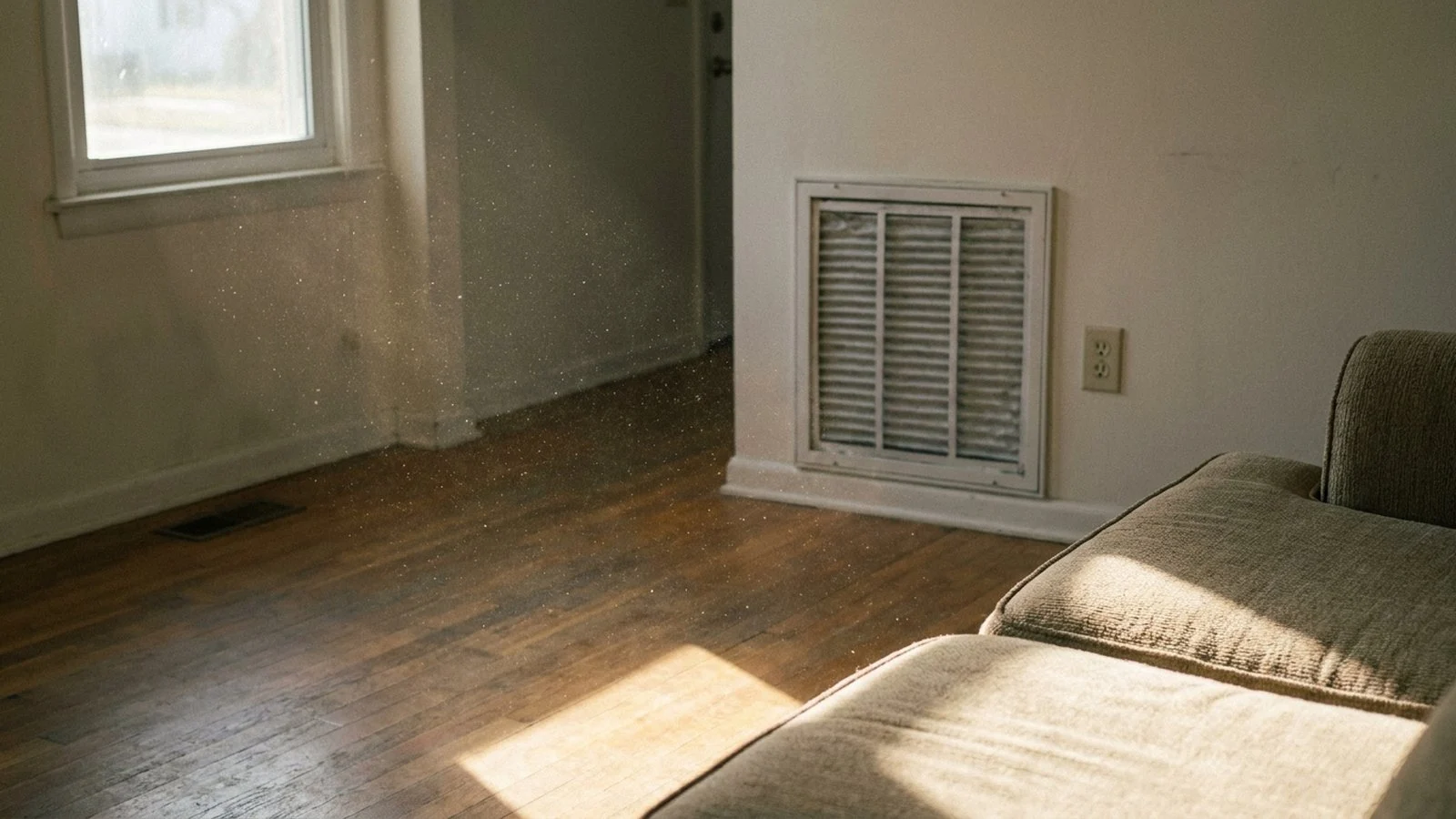
Why is my house so dusty? What actually causes it
Household dust is not one thing. It is a mix, and the mix is different in every home. Once you can see the three streams that feed it, the reason it keeps coming back stops being a mystery.
The part that blows and walks in from outside
The symptom: the dust is worst near the front door, the windows, and the rooms you enter first after being outside. It looks slightly gritty or sandy, not just soft and gray.
Why it happens: your indoor and outdoor air are never sealed off from each other. The EPA notes that outdoor air is always coming into your home through open doors and windows and through small cracks and crevices, carrying pollen, soil, and fine particles with it. On top of that, everyone tracks in soil on shoes and clothing. A large share of what you call house dust started life outside your walls.
The fix in one line: stop it at the threshold. A coarse outdoor mat plus a washable indoor mat, and a shoes off habit near the door, cut the tracked in load before it ever reaches the living room.
The part your own home sheds
The symptom: the film is soft, light gray, and heaviest where fabric lives, so the bedroom, the couch, and anywhere with carpet or curtains.
Why it happens: fabric is a dust factory. Bedding, upholstery, rugs, towels, and clothing constantly shed fibers, and those fibers combine with dead skin cells and pet dander to make the classic gray fluff. Carpet is the biggest reservoir of all, because it holds particles deep in the pile and releases them every time someone walks across it. If you share your home with a dog or cat, this stream is much larger, which is the same reason carpet and soft flooring hold onto pet mess and odor so stubbornly.
The fix in one line: reduce the number of fabric surfaces you cannot easily wash, and clean the ones you keep on a schedule instead of by feel.
The part that is alive
The symptom: you do not see this one, but you feel it, with a stuffy nose or itchy eyes that are worse in bed or in the morning.
Why it happens: a portion of house dust is dust mites and the waste they leave behind. According to the American Lung Association, dust mites feed on the dead skin cells people shed, and they absorb moisture straight from the air rather than drinking it. That is why they thrive in bedding and soft furniture, and why humidity matters so much, which we come back to below.
How to reduce dust in your house, room by room
You will never hit zero dust, and chasing that number will only wear you out. The goal is to slow the rate at which it settles so a clean surface stays clean for days, not hours. The order below matters, because it starts where dust is densest.
Start in the bedroom
Your bed is the single biggest dust and dust mite site in most homes, and it is also where you breathe for eight hours straight. Wash sheets and pillowcases weekly in hot water. The American Lung Association recommends water of at least 120 degrees Fahrenheit, because warm water leaves mites alive. Keep clutter off the floor and off open shelves, since every stacked object is a flat surface collecting particles you then have to dust around.
Change how you dust and vacuum, not just how often
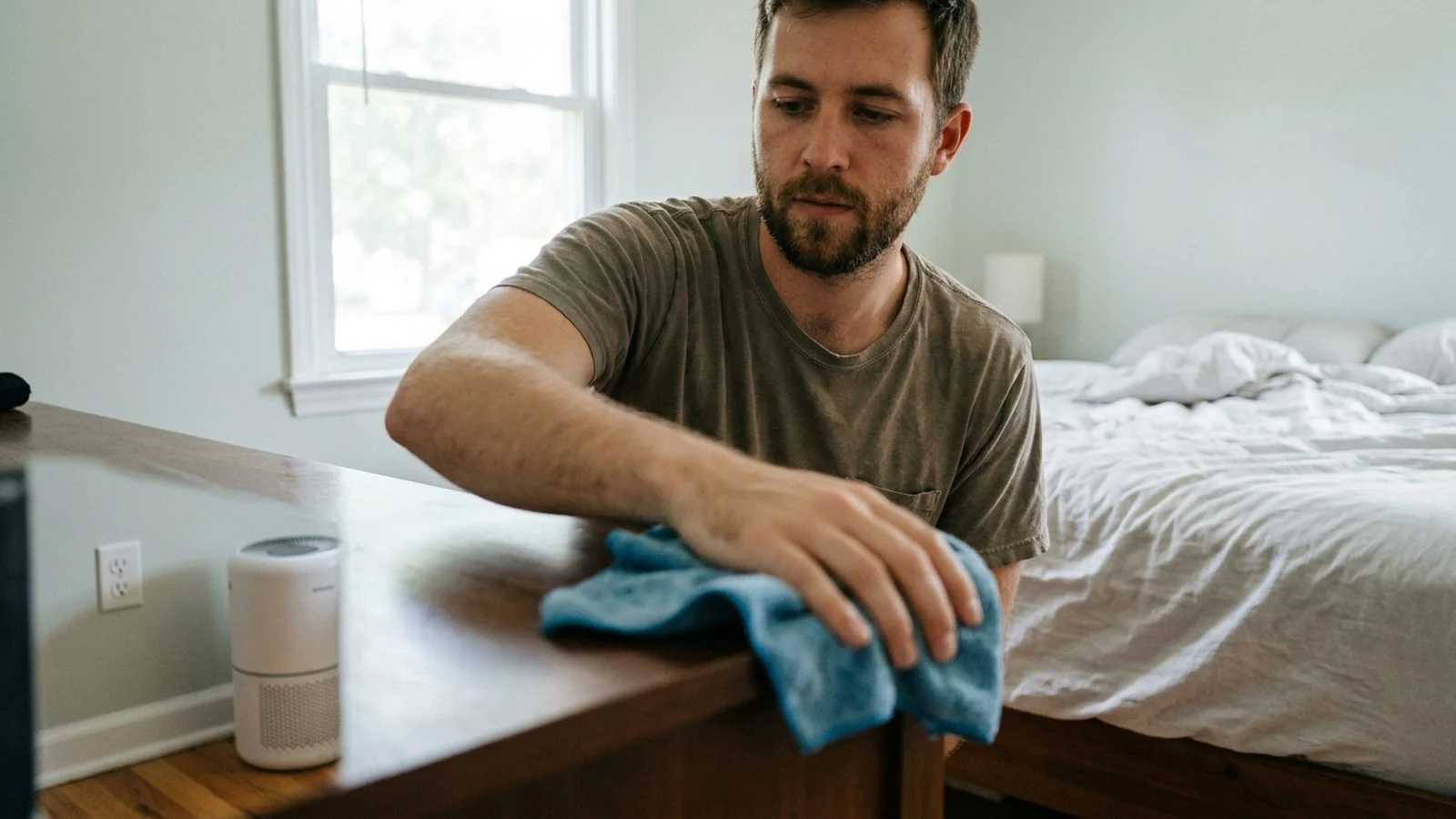
Dry feather dusters and dry cloths mostly launch dust into the air, where it drifts and lands again an hour later. Switch to a slightly damp microfiber cloth, which traps particles instead of scattering them, and work from high surfaces down to low ones so anything you knock loose lands on a spot you have not cleaned yet. For floors, a vacuum with a sealed HEPA style filter matters more than raw suction, because a leaky vacuum blows the finest particles right back out the exhaust. The EPA suggests vacuuming carpets and furniture every week, or more often in high traffic homes. If a weekly rhythm sounds like a lot, anchoring it to a fixed day helps, and a simple room by room cleaning routine keeps it from piling up.
Treat the air itself
Cleaning surfaces only catches dust that has already landed. To lower what is floating, you have two levers. The first is your heating and cooling filter. The EPA advises choosing a filter with at least a MERV 13 rating, or as high a rating as your system fan and filter slot can safely handle, since MERV 13 captures a large share of the fine particles in the 0.3 to 10 micron range that make up airborne dust. The second lever is a standalone air purifier for the room where you spend the most time, which pulls particles out of the air continuously while it runs.
Pull the humidity down
Because dust mites drink from the air, drying the air out is one of the few things that reduces the living part of dust rather than just relocating it. Keep indoor humidity below 50 percent. In a damp basement or a humid climate, that usually means running a dehumidifier or the air conditioning during the muggy months, and checking the level with an inexpensive hygrometer rather than guessing.
The 7-day test to find your biggest dust source
Every home has one stream of dust that dominates, and fixing that one moves the needle far more than scrubbing everything equally. Here is a seven day method to find yours without any special tools.
- Day 1: pick three test spots, one high shelf, one nightstand, and one hard floor near your main door. Wipe all three completely clean and note the time.
- Days 2 to 4: do not clean those three spots. Once a day, run a fingertip across each and rank which one refilled fastest and heaviest. The spot near the door tells you about tracked in dust, the nightstand tells you about bedding and skin, the shelf tells you about general airborne fibers.
- Day 5: look at the dust itself in good light. Gritty and dark points to outside soil. Soft and light gray points to fabric and skin. Fine and even everywhere points to airborne particles your filter is missing.
- Days 6 to 7: apply only the one fix that matches your worst spot, the door mat and shoes off routine, or the bedding and vacuum change, or the filter and purifier, and re wipe to feel the difference.
At the end of the week you will know which of the three streams is really driving your dust, so you can spend your effort where it pays off instead of everywhere at once.
Gear that genuinely helps, and who should skip it
You do not need to buy anything to run the test above. But once you know your main source, one or two purchases can do real work. Prices move week to week, so treat these as rough ranges, not fixed numbers, and never as a promise that a gadget fixes everything.
A vacuum with a sealed HEPA style filter. Worth it if you have carpet, rugs, or pets, because it captures fine particles instead of recirculating them. Skip it if your home is mostly hard floors and you already have a decent vacuum, since a damp mop does more there. The real trade off is maintenance: sealed filters need periodic replacement, and that ongoing cost is part of the price. Expect a wide range from budget uprights to premium cordless models.
A true HEPA air purifier. Worth it for a bedroom or the one room where you spend hours, especially if allergies flare indoors. It is not worth buying one per room, and it does nothing about dust that has already settled or that you kick up off the couch. Match the unit to the room square footage, because an undersized purifier in a large room mostly makes noise. Replacement filters are a recurring expense.
A dehumidifier. Worth it if your test points to the living, mite driven stream, or if a room feels damp. Useless, and just an energy bill, in an already dry home or climate. Size it to the space and empty or drain it on a routine, since a full tank simply shuts off.
None of these replaces the basics of stopping dust at the door and cleaning fabric on a schedule. They lower the load. They do not erase it, and any product that claims to is overselling.
When it’s not just dust
Most dusty homes are normal homes, and everything above will help. A few situations are different, and no cleaning routine is the right answer for them.
If wiping and vacuuming barely change anything, and symptoms like coughing or congestion stick around, the issue may be your ductwork or heating and cooling system pushing particles around, and that calls for an HVAC inspection rather than more dusting. If you see dust that is unusually fine and clings, or you smell a musty odor, you could be dealing with mold spores rather than ordinary dust, which is a moisture problem to diagnose and fix, not a surface to wipe. And if one person in the home has persistent allergy or asthma symptoms, a doctor or allergist can test for specific triggers, since dust mite allergy is treatable and worth naming rather than guessing at. Clutter also quietly multiplies dust by creating more surfaces for it to land on, so if the whole house feels like a losing battle, thinning things out with a basic room by room organizing plan often does more than any tool.
Read also
- Simple cleaning routine for a tidy home: a room by room guide
- Best carpet cleaner with pets: spot cleaners vs upright units
- Home organization for beginners: a simple room by room guide
- Small space living: smart ideas to make a small home feel bigger
Sources
- American Lung Association, Dust Mites
- US EPA, Sources of Indoor Particulate Matter (PM)
- US EPA, What is a MERV rating?
Frequently Asked Questions
Why is my house so dusty even after cleaning?
Because dust is replaced faster than you remove it. Fibers from fabric, dead skin, pet dander, and soil tracked in from outside settle within hours, and dry dusting lifts particles back into the air instead of trapping them. A damp microfiber cloth and a sealed vacuum actually hold the dust you collect.
Does one room really get dustier than the rest of the house?
Often yes. The room nearest an exterior door, or the one with the most carpet and soft furniture, usually leads. The seven day dust test in this guide helps you spot which room and which source is driving most of your dust.
Will an air purifier stop dust from settling?
It lowers airborne particles while it runs, so surfaces build up more slowly, but it does not remove dust that has already settled or that you stir up off fabric. Treat it as one layer of the fix, not the whole solution.
What humidity level keeps dust mites down?
Keeping indoor humidity below 50 percent limits dust mites, because they absorb moisture from the air to survive. The American Lung Association recommends staying under that mark and washing bedding weekly in hot water of at least 120 degrees Fahrenheit.
Is it normal for a house to be this dusty?
Yes. Every home constantly makes and pulls in dust from fabric, skin, pets, and outdoor air, so a light film returning between cleanings is normal. The goal is to slow how fast dust settles, not to reach zero, which is not a realistic target.