

You measured the closet, the shelf, the space under the bed, and still ran out of room. So you looked at the back of a door and realized it is the one flat surface in the house doing nothing. That is the moment most people buy an over the door organizer, and it is also the moment most of them buy the wrong one.
The reason is not brand quality. It is that the product is sold by what it holds, while it actually succeeds or fails on two numbers almost no listing puts up front: how thick your door is, and how much clearance sits between the top of the door and the frame. Get those wrong and the door scrapes, sticks, or will not latch at all.
This guide covers what the format genuinely solves, the measurements that decide whether it fits, which style belongs in which room, a seven day test before you spend anything, and the situation where hanging anything on the door is a bad idea and in some buildings not allowed.
As an Amazon Associate I earn from qualifying purchases.
What an over the door organizer really solves
The symptom: your closet is full, the floor is covered with bins, and the things you actually reach for daily are the hardest to get to.
Why it happens: most home storage is deep. Shelves, cabinets, and bins stack items behind other items, so anything not in front becomes invisible. Small homes lose more to this than large ones, because there is no second location to overflow into.
The adjustment: a door back is shallow, vertical, and fully visible at a glance. That makes it the wrong place for bulk and the right place for many small items you use often. This is the whole logic of the format. It converts one flat plane into single depth storage where nothing hides behind anything else.
Which means the honest use case is narrower than the marketing suggests. It is excellent for spice jars, cleaning bottles, toiletries, wraps and foil, craft supplies, and pantry packets. It is poor for anything heavy, anything deep, and anything you rarely touch. If your storage problem is volume rather than visibility, a door will not solve it, and a broader room by room organizing approach gets you further.
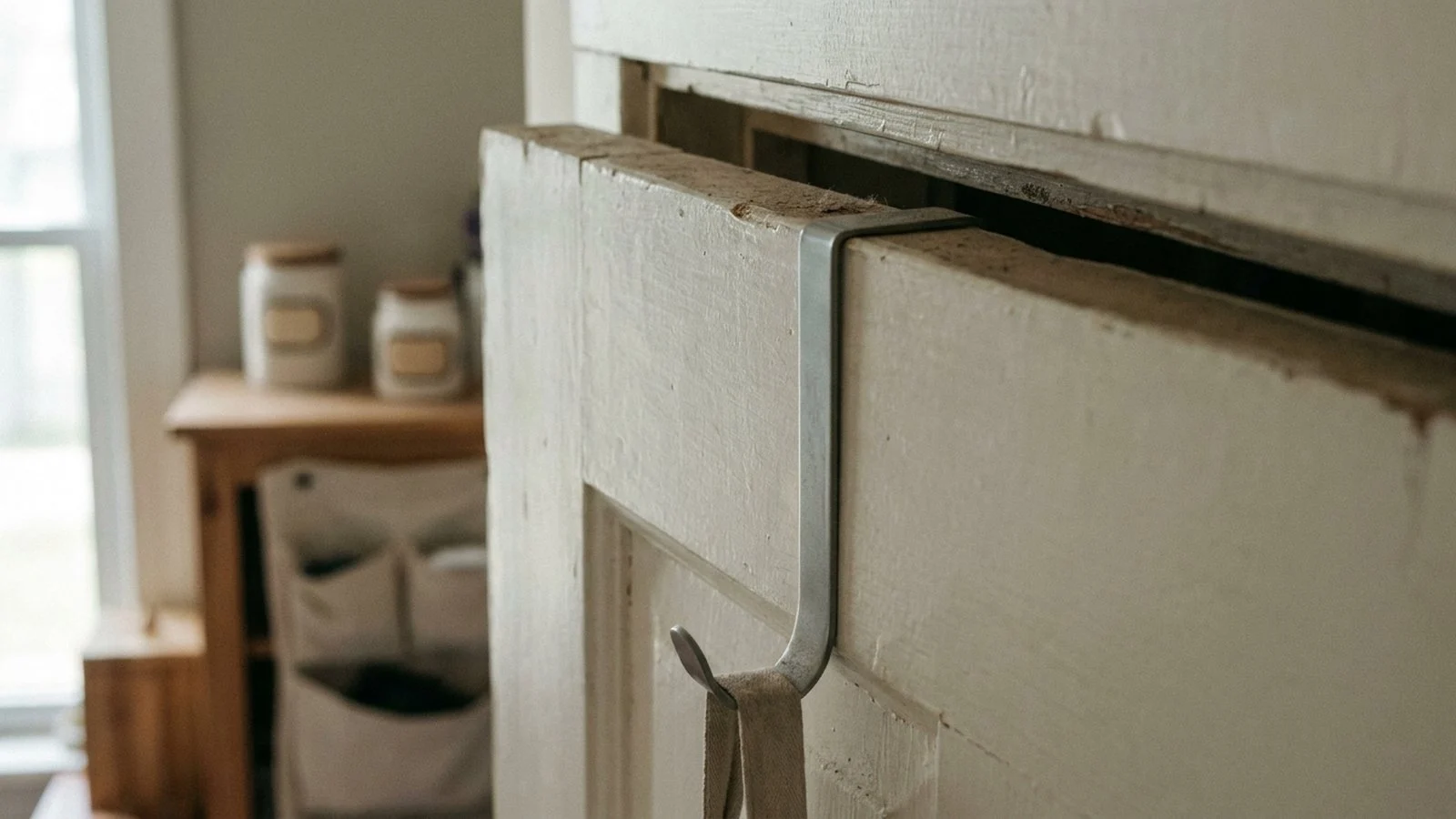
The two measurements that decide if it fits
Door thickness, and why 35 mm matters
Over the door hooks are made for a thickness range, and going outside it means the hooks either will not seat or will rattle loose. In the United States two thicknesses dominate. The International Existing Building Code, in its section on corridor doors, requires dwelling unit corridor doors in certain residential occupancies to be not less than 1 3/8 inch, which is 35 mm, of solid core wood or an approved equivalent, and specifies that replacement doors be 1 3/4 inch, or 44 mm, unless the existing frame will accommodate only the thinner one. Those two figures, 35 mm and 44 mm, are the ones your hooks have to clear.
Measure your own door with a ruler at the top edge, not at the handle. Then check the listing for a stated maximum door thickness. If the listing does not state one, treat that as a warning rather than an oversight.
The clearance above the door
The hook has to pass over the top of the door and still let it close. Most interior doors have only a small gap between the door top and the frame. If the hook is thicker than that gap, the door will bind against the frame, and you will feel it as a door that suddenly needs a shove.
Slim steel hooks solve this. Thick padded hooks look gentler on the paint and cause more binding. If your door already sits tight in its frame, choose the thinnest hook you can find, or skip the format.
Weight, hinges, and the part people ignore
Hinges are sized for the door, not for the door plus a loaded rack. A full pantry organizer with jars and bottles adds real weight at the worst possible place, far from the hinge axis. Over months this shows up as a door that drops slightly and starts to catch on the strike plate.
The practical rule: fabric pocket panels are light enough that this rarely matters. Steel racks holding glass jars are not. If you load a heavy one, expect to tighten hinge screws at some point, and use longer screws into the frame stud if the door starts to sag.

Which style belongs in which room
Prices in this category move with sales, so read the bands below as rough positioning and check the current price before buying.
Fabric pocket panels. Usually the cheapest tier, roughly the ten to twenty dollar range. Worth it for lightweight small items, so toiletries, socks, craft supplies, packets. Not worth it for anything with weight or sharp corners, since the pockets sag and tear at the seams first. The trade off is price against durability, and the seams are always the failure point.
Steel racks with adjustable baskets. Mid to upper tier, often the thirty to seventy dollar range. This is the pantry and cleaning cupboard option, and it absorbs the two most common searches in this category, the pantry organizer and the bathroom organizer. Worth it if you are storing cans, bottles, and jars and you want depth adjustment. Not worth it on a hollow core door that already flexes, or on a door with tight clearance, because these have the thickest hooks. The trade off is capacity against weight and fit.
Slim hook rails and bar systems. Low to mid tier. Worth it in a bathroom for towels and robes, or on a bedroom door for bags and coats, where the point is hanging rather than containing. Not worth it if you need items visible and separated, since everything ends up layered on the same hook. The trade off is simplicity against organization.
Clear pocket organizers. Mid tier. Worth it when finding things fast matters more than looks, which is usually the bathroom, the cleaning cupboard, or a craft area. Not worth it in a room where you care about how it looks, because a wall of clear plastic pockets reads as clutter even when it is tidy. The trade off is visibility against appearance, and this is the same tension that makes small rooms feel smaller when every surface is working.
Skip the format entirely if the door in question is the one you use most in a small hallway. Anything on it will be brushed against daily, and it will not survive.
The 7-day test before you buy anything
This costs nothing and answers the question for your door and your habits, not for a generic house.
- Day 1: measure the door thickness at the top edge and write the number down. Then slide a folded piece of cardboard over the top of the door and close it. If the door binds, your clearance is tight and you need the slimmest hook available.
- Day 2: gather the items you think will live on the door and put them in a box. Weigh the box on a bathroom scale. Anything above roughly fifteen pounds should make you reconsider a fabric panel.
- Days 3 to 6: leave that box on the floor next to the door and use only from it. Each evening, note which items you actually touched.
- Day 7: count. If you reached for most of the box daily, the door is a good home for it. If you touched three items out of twenty, you were about to hang storage for things that should be stored elsewhere, or removed, which is the more common outcome and the reason decluttering first changes the math.
The test also settles the depth question. If nothing in your box is deeper than a spice jar, a door works. If half of it is, you need a shelf.
When it’s not allowed, or not a good idea
Most interior doors are fine. A few are not, and one case is a genuine safety and compliance issue rather than a preference.
Fire rated doors, which many apartments have. The door between your unit and a shared corridor is often a fire door, and what may be attached to it is governed by NFPA 80, the standard for fire doors and other opening protectives. The National Fire Protection Association states plainly that fire doors must always be operable, and that operability includes opening, closing, and latching. It also notes that blocking or wedging doors open is prohibited, and that inspections include checking the clearance around the door. Even for something as modest as signage, NFPA 80 limits combustible signs to 5 percent of the door face, roughly a 12 inch square on a standard 36 by 80 inch door, restricts how it may be fastened, and states it cannot interfere with the operation of the door. An over the door organizer sits directly in that clearance, adds weight, and can stop a door latching. On a fire door, do not use one, and check with your building manager if you are unsure which of your doors is rated.
Hollow core doors carrying weight. The hooks bear on the top rail, which on a hollow core door is a thin strip of wood. Heavy loads crush it from the inside where you cannot see the damage until the door is ruined.
Rentals with deposit terms. Hooks mark paint and veneer at the top edge over time. That is a small repair, but it is a repair. A felt or thin cloth strip under the hook prevents most of it.
Doors that already stick. If a door drags or fails to latch now, adding a rack makes it worse, not the same. Fix the hinge or the strike plate first, which is a small job of the kind covered in simple beginner home repairs.
Read also
- Home organization for beginners: a simple room by room guide
- Top closet shelf organizer: a step by step for the high shelf
- Small space living: smart ideas to make a small home feel bigger
- How to declutter when overwhelmed: the one box method
Sources
- National Fire Protection Association, Frequently Asked Questions About Fire Doors and NFPA 80
- International Code Council, 2018 International Existing Building Code, Section 805.5.1 Corridor doors
Perguntas frequentes
Will an over the door organizer damage my door?
The usual damage is cosmetic, a mark or worn finish at the top edge where the hooks sit. A felt or cloth strip under each hook prevents most of it. Real damage happens on hollow core doors carrying heavy loads, because the hooks bear on a thin top rail that can crush from the inside.
How do I know if it will fit my door?
Measure the door thickness at the top edge and compare it to the maximum thickness in the listing. In the United States the two common figures are 1 3/8 inch, which is 35 mm, and 1 3/4 inch, or 44 mm. Then check the gap above the door, because a thick hook in a tight gap makes the door bind.
Can I hang one on my apartment entry door?
Often no. That door is frequently a fire rated door, and NFPA 80 requires fire doors to stay operable, meaning they open, close and latch, with clearance around the door checked at inspection. An organizer sits in that clearance and adds weight. Ask your building manager which doors are rated.
How much weight can an over the door organizer hold?
It depends far more on the door and hinges than on the rack. Fabric panels with light items are rarely a problem. Steel racks loaded with jars and bottles add weight far from the hinge axis, which over time can make the door drop and catch on the strike plate.
Is a fabric pocket organizer or a steel rack better?
Fabric is cheaper and lighter, and fails at the seams once you load it with anything heavy or sharp. Steel racks hold cans and bottles properly but have thicker hooks, so they need more clearance and a solid door. Match the material to the weight of what you are storing.