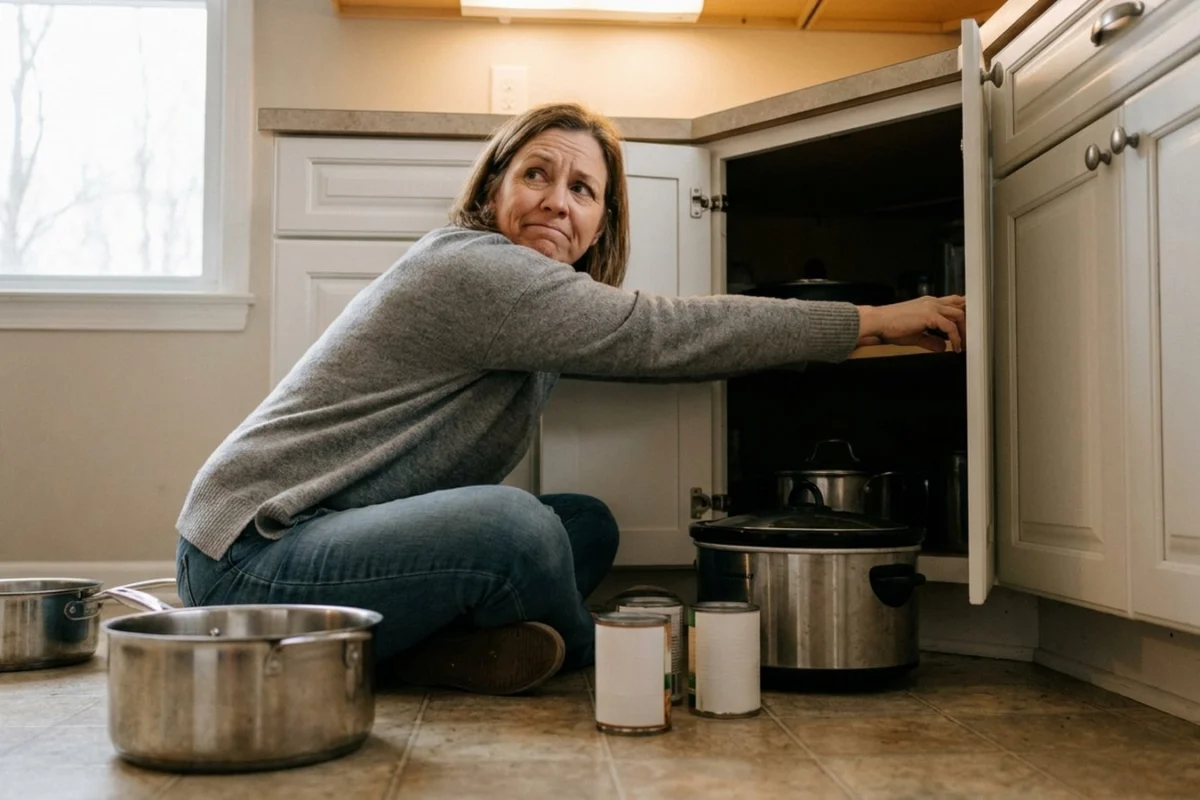
Every kitchen has one cabinet that has quietly given up. It is usually the corner one, and the back of it holds a slow cooker you forgot about, two cans past their date, and a baking dish you have replaced twice because you could not see it. That is the cabinet a lazy susan for cabinet corners is supposed to rescue.
Sometimes it does. Often people buy one, get it home, and find it will not clear the hinge, or it spins into the door frame, or it fits but holds less than the shelf it replaced. The product is not the problem. The corner cabinet you have is one of two very different things, and only one of them takes a turntable well.
This guide covers what the format genuinely fixes, how to measure yours properly, which type suits which cabinet, a seven day test to run before you spend anything, and the cases where a rotating shelf is the wrong answer or an actively bad place to keep food.
As an Amazon Associate I earn from qualifying purchases.
What a lazy susan for cabinet corners actually fixes
The symptom: the front six inches of the cabinet get used daily and everything behind that line becomes archaeology.
Why it happens: a corner base cabinet is deep and it turns. To reach the back you have to get low, put your head near the opening, and pull out the front row first. Almost nobody does that repeatedly, so the back becomes dead storage in a kitchen that has no space to waste.
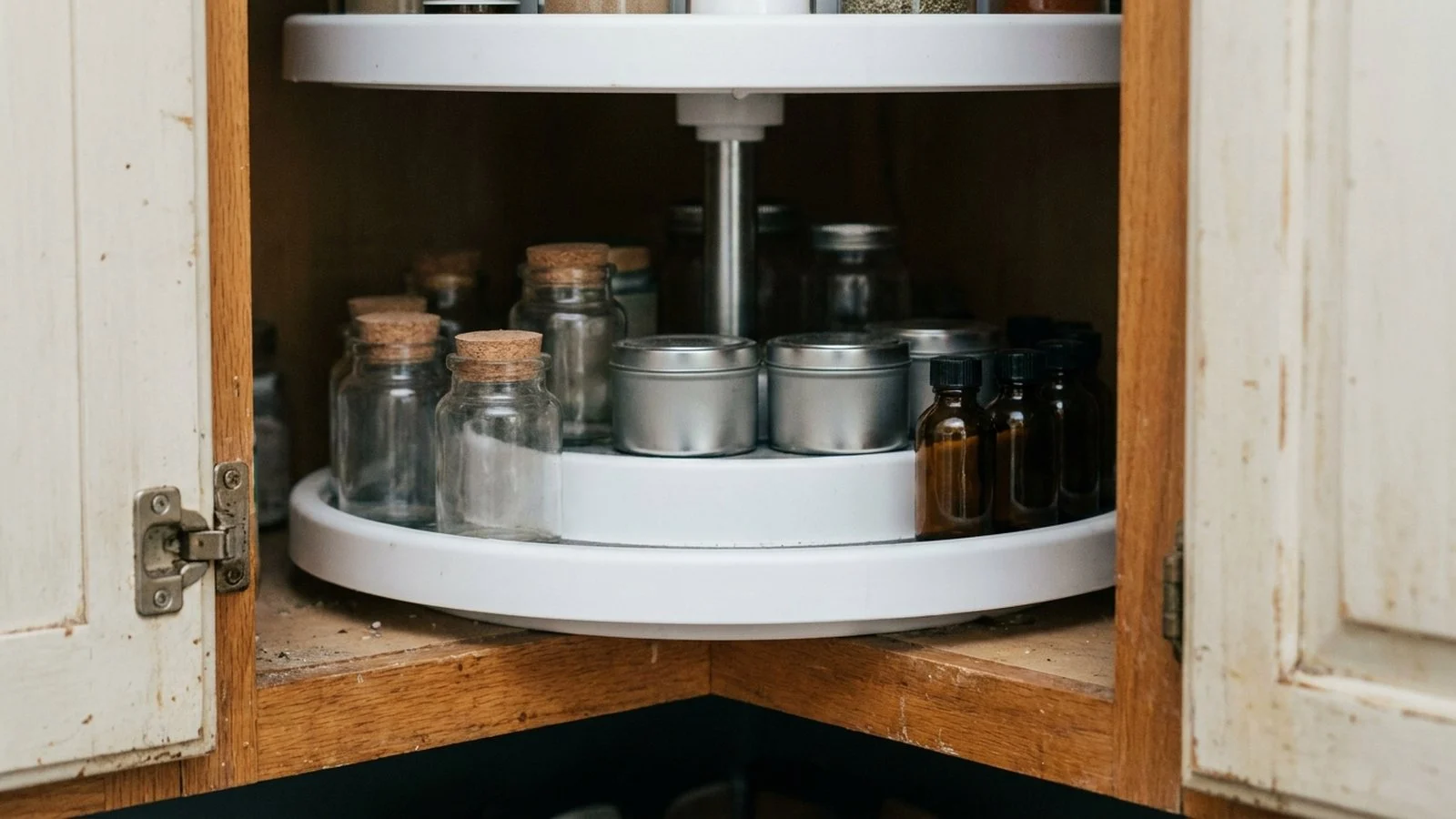
The adjustment: a turntable changes the geometry. Instead of you reaching into the depth, the depth rotates out to you. Everything gets a turn at the front, which is why the format survives despite being older than most kitchen trends.
That also defines what it is bad at. Rotation only helps items that are stable when they move. Tall bottles tip, stacked plates slide, and anything heavy makes the whole thing hard to turn. It solves visibility and reach, not capacity, and if your real problem is that you own more than the kitchen holds, a rotating shelf will not fix it and thinning things out first will.
How to measure for a lazy susan before you buy
This is where most purchases go wrong, and it takes about five minutes to get right.
First, find out which corner you have
Open the door and look. If the cabinet opening sits at an angle across the corner, or if two doors meet in a folding pair, you have a true corner cabinet and a turntable is designed for it. If the opening is a normal flat door and the cabinet continues sideways into darkness behind the neighboring cabinet, you have a blind corner. Blind corners are the ones that swallow things, and a round turntable is a poor fit because the shape of the space is not round. That case is covered further down.
Then take three numbers
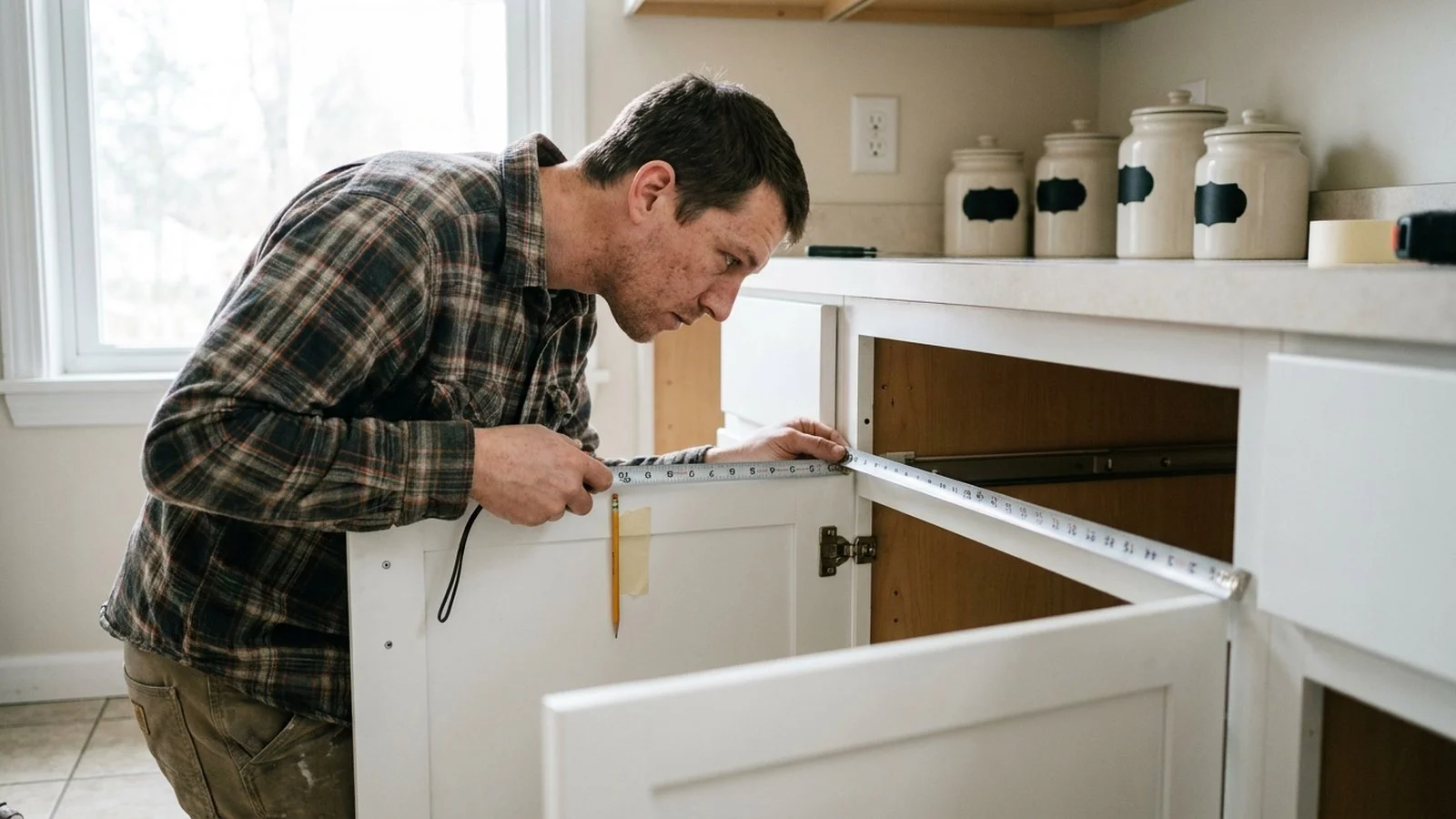
Measure the interior width at the widest point, the depth from the back to the inside face of the door frame, and the vertical clearance between shelves. Take the smaller of width and depth, then subtract about an inch for clearance so the tray does not scrape. That result is your maximum diameter, not the number you wish it were.
The number people forget is vertical. Measure the height of the tallest item you plan to store, not the shelf gap, because a two tier unit divides that space and can leave you with two shelves too short to be useful.
Check what the door does
Close the door and watch the hinge. Hinges and the door frame lip intrude into the opening, and on many cabinets the usable opening is noticeably narrower than the interior. A tray sized to the interior may simply not pass through the doorway. Measure the opening too, and buy for the smaller of the two.
Which type fits which cabinet
Prices move with sales, so treat these as rough positioning and check before buying.
Single tier drop in turntables. Usually the cheapest tier, roughly the ten to twenty five dollar range. Worth it for spices, oils, condiments, and cleaning bottles, and for anyone who wants a fix with no installation and no commitment. Not worth it as a solution for a deep corner base cabinet, because one tray on one shelf leaves the vertical space above it unused. The trade off is simplicity against how little of the cabinet it actually recovers.
Two tier turntables. Mid tier, often the twenty five to fifty dollar range. Worth it when your items are short and uniform, so jars, cans, and small bottles. Not worth it if you store anything tall, since the middle deck sets a hard height limit you cannot change later. The trade off is capacity against flexibility.
Full built in corner units, the round or kidney shaped kind mounted on a pole or to the shelves. Upper tier, often the sixty to one hundred fifty dollar range and sometimes beyond. Worth it in a true corner base cabinet you use daily, where recovering the whole volume changes how the kitchen works. Not worth it if you rent, or if you are not comfortable with an installation that involves drilling into the cabinet. The trade off is cost and permanence against actually solving the corner.
Blind corner pull out systems. The highest tier by a distance, commonly in the hundred and fifty dollar range and up. These are not turntables. They are hinged trays that swing the hidden section out through the door. Worth it for a blind corner you rely on, because nothing else reaches that space. Not worth it for a cabinet you open twice a year. The trade off is real money and installation against the only genuine fix for that layout.
One buying note that applies to all of them: check the bearing, not the tray. A cheap bearing under load makes the unit stiff, and a stiff turntable stops getting turned, at which point you are back to a dead corner.
The 7-day test before you spend anything
Run this first. It costs nothing and it decides both whether you need one and which size.
- Day 1: empty the corner cabinet completely onto the counter. Take the three measurements above and write them on a piece of tape stuck inside the cabinet door, where you will still have them at the store.
- Day 2: put back only what you are certain you use. Leave the rest in a box on the floor.
- Days 3 to 6: live normally. Every time you take something from the box, move it into the cabinet. Every time you reach into the back of the cabinet, make a mark on the tape.
- Day 7: read the results. If the box is still mostly full, you did not have a corner problem, you had too much in the kitchen. If the tape has many marks, the corner is in daily use and a full built in unit will pay for itself. If it has two marks, a cheap drop in tray is enough.
The test also tells you the height question honestly, because by day seven you know the tallest thing that genuinely lives there, which is the number that rules out two tier units.
When it’s not the right fix
Three situations where a turntable is the wrong buy, and one is a food safety issue rather than a convenience one.
Corner cabinets next to the oven, the dishwasher, or under the sink. If you plan to store food there, heat and damp matter more than organization. Guidance from the National Center for Home Food Preservation at the University of Georgia puts numbers on it: dried foods should be kept in cool, dry, dark areas, and because quality is affected by heat, the higher the temperature the shorter the storage time. It gives most dried fruit about one year at 60 degrees Fahrenheit against roughly six months at 80. A cabinet sharing a wall with an oven or a dishwasher runs warm, and under a sink runs damp. Put pans, cleaning supplies, or appliances in those, and keep food in a cooler cabinet.
Cabinets that sit outside comfortable reach. A turntable brings items forward, but it cannot raise a cabinet or lower it. For reference, the US Access Board describes accessible reach ranges as roughly 15 inches to 48 inches above the floor when unobstructed, dropping to a 44 inch maximum for a forward reach over an obstruction deeper than 20 inches, and 46 inches for a side reach over an obstruction deeper than 10 inches. Those figures are written for accessible design rather than for kitchens generally, but they are a useful sanity check: if the contents sit well outside that band, or the reach passes over a deep counter, rotation is not the constraint and moving what lives there is the better fix.
Heavy appliances and stacked dishes. Stand mixers, cast iron, and tall stacks belong on a fixed shelf. Weight makes a turntable stiff, and stacks slide when the tray starts and stops. A pull out drawer or a plain shelf is better for those, and the broader logic of putting each thing where its shape and weight belong is the same one behind a workable room by room organizing plan.
Blind corners. Worth repeating, because it is the most common mismatch. A round tray in a rectangular hidden space leaves the far section as empty as before. If that is your layout, either buy the pull out system or accept the corner as long term storage for things you need twice a year.
Read also
- Home organization for beginners: a simple room by room guide
- Top closet shelf organizer: a step by step for the high shelf
- How to declutter when overwhelmed: the one box method
- Small space living: smart ideas to make a small home feel bigger
Sources
- US Access Board, Guide to the ADA Standards, Chapter 3: Operable Parts (reach ranges)
- National Center for Home Food Preservation, University of Georgia, Packaging and Storing Dried Foods
Perguntas frequentes
How do I measure for a lazy susan?
Measure the interior width at its widest, the depth from the back to the inside of the door frame, and the vertical gap between shelves. Take the smaller of width and depth and subtract about an inch for clearance. Also measure the door opening, since hinges narrow it, and buy for whichever number is smaller.
What is the difference between a corner cabinet and a blind corner?
A true corner cabinet has its opening angled across the corner, or two doors meeting in a pair, and suits a round turntable. A blind corner has a normal flat door with the cabinet continuing sideways into a hidden section. A round tray cannot reach that hidden part, so a pull out system is the fix there.
Can I put a lazy susan in the cabinet next to my oven?
You can, but think about what goes on it. Guidance from the National Center for Home Food Preservation notes that dried foods keep best in cool, dry, dark places and that higher temperatures shorten storage time, roughly a year at 60 degrees against six months at 80. Use warm cabinets for pans and cleaning supplies, not food.
Why does my lazy susan spin badly or stick?
Usually the bearing, not the tray. A low quality bearing gets stiff under weight, and an overloaded or unevenly loaded tray makes it worse. Check that nothing is catching on the door frame or hinge, and keep heavy items low and centered rather than out at the edge.
Is a two tier turntable better than a single tier?
Only if your items are short. A second deck adds capacity but sets a fixed height limit you cannot change later, so tall bottles and boxes will not fit. Measure the tallest thing you actually store there first, then decide.